Abstract: This article examines Buddhism's pioneering role
as history's first organized missionary religion, originating in 5th-century
BCE India. It attributes Buddhism's rapid continental spread ("like
wildfire") to its practical solution for universal suffering (dukkha)
centered on compassion (karuṇā), ethical conduct, and the revolutionary
monastic community (Sangha). The analysis traces Buddhism's profound
evolution over 1500 years: geographic dispersion spurred local adaptation,
doctrinal fragmentation ("speciation") into schools like Mahayana and
Vajrayana/Tantrism, and a shift towards ritual and deity propitiation to
address worldly concerns. This evolution created a complex, intertwined
relationship with Brahmanism. While fundamentally antithetical (inclusive
proselytizing vs. exclusive birthright), later Buddhist elements, particularly
Tantric practices, were absorbed into evolving Brahmanism, contributing to
early Hinduism. Concurrently, the article argues that Buddhism in India lost
its distinct identity and expansive drive. This internal transformation,
coupled with the rise of a rigid, exclusive Brahmanical social order
("closed jar"), is posited as a critical factor in societal
stagnation, moral decline, and India's subsequent vulnerability to foreign
conquest. 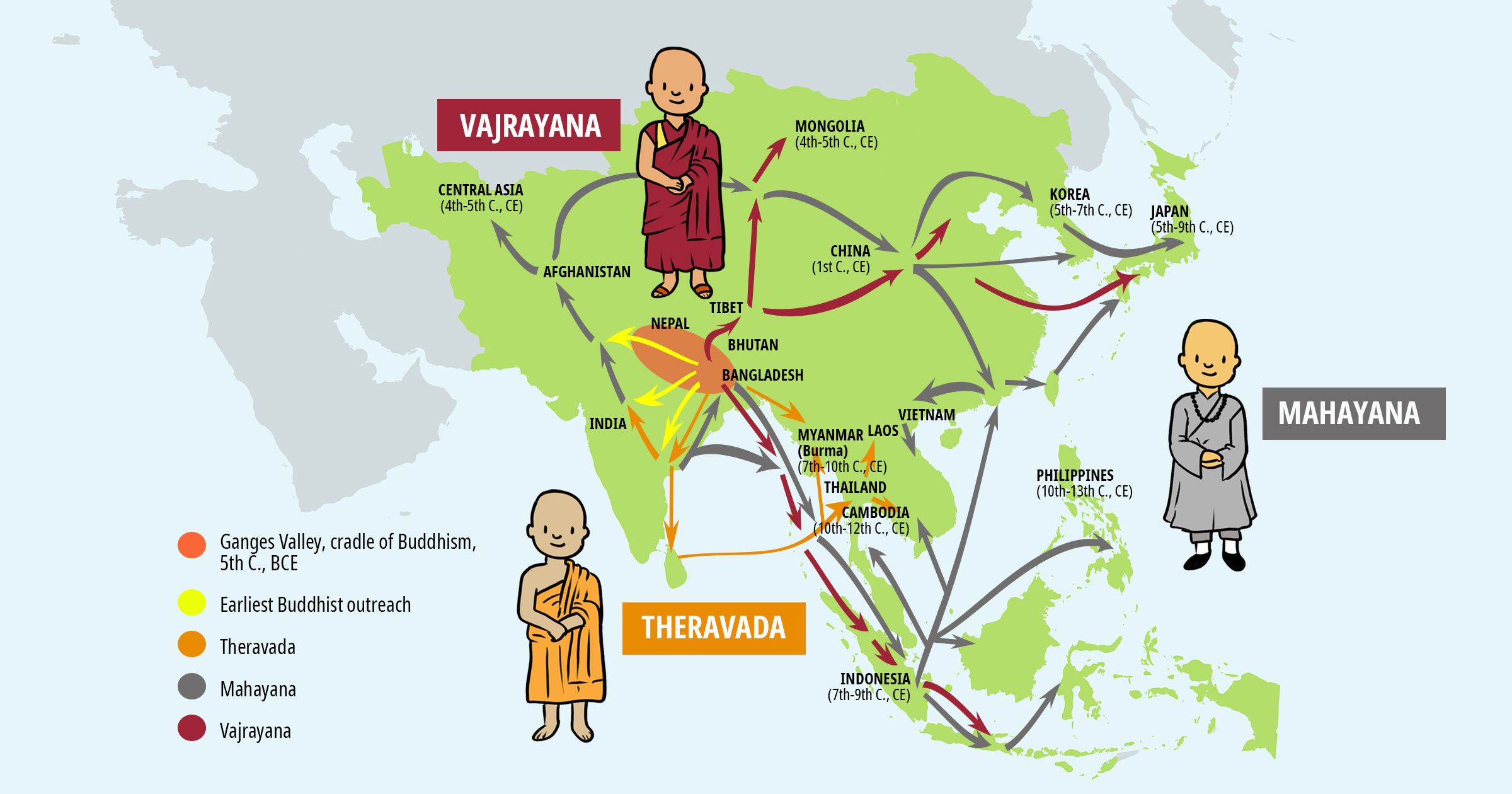 Photo credit: Buddhism.net
PART - I
Buddhism holds a unique place in human history as the world’s first organized, missionary religion. Emerging in northeastern India around 500 BCE, it pioneered a model of active proselytization, sending monks across continents to share its teachings. Its core message – centered on alleviating universal suffering (dukkha) through compassion, ethical conduct, and mental discipline – resonated powerfully in a world defined by subsistence farming, hunter-gatherer transitions, and pervasive hardship.
The Engine of Early Success: Compassion and
Community
Buddhism offered practical solutions to life’s inherent pain. It taught compassion
(karuṇā) as a fundamental human principle, urging followers to
actively relieve distress. Its revolutionary innovation was the Sangha –
a disciplined monastic order. This structure provided not only spiritual
guidance but also a blueprint for large-scale social organization. The Sangha
fostered ethical communities, offered refuge, and became a visible symbol of
the religion’s "fruits." This potent combination – addressing existential
suffering while building resilient communities – fueled Buddhism’s rapid spread
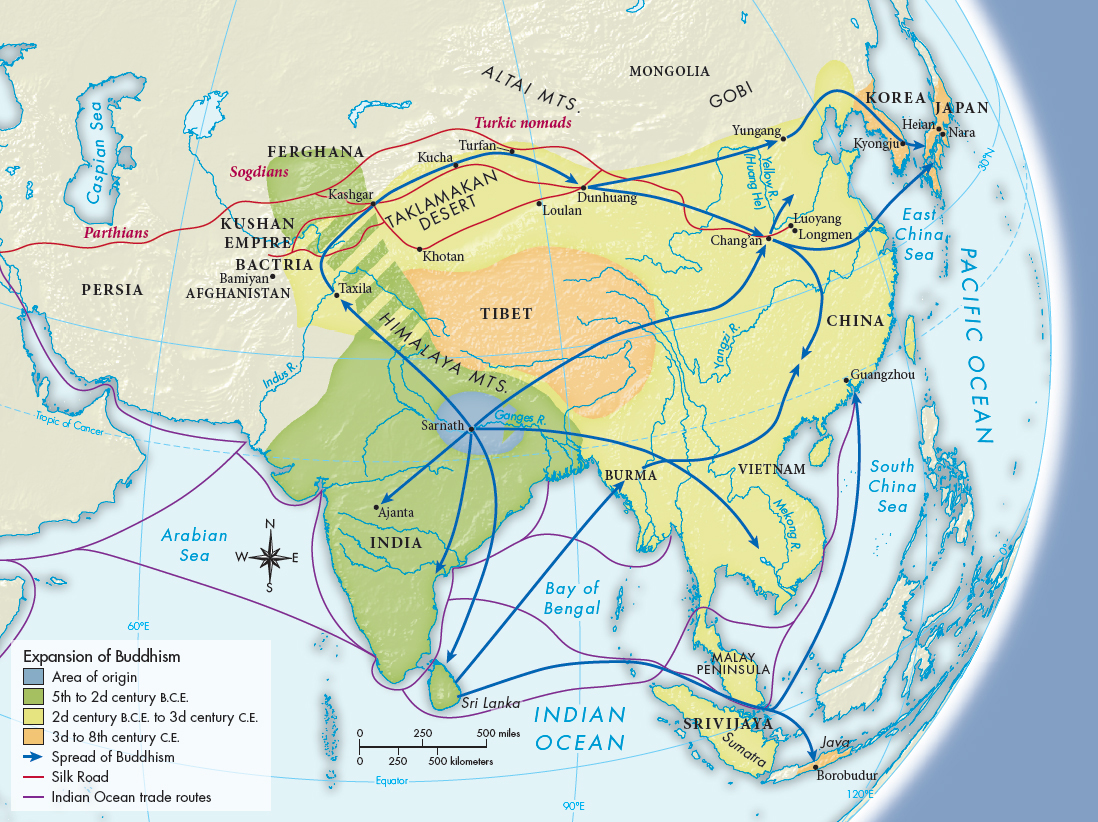
"like wildfire." Wherever humans traveled on foot – throughout the
Indian subcontinent, and subsequently into West Asia, Central Asia, East Asia,
and Southeast Asia – Buddhism took root.
Evolution and "Speciation": The Price of
Success
The period spanning 1500 years (500 BCE to 1000 CE) was vast, occurring long
before modern mass communication. Buddhism’s very success sowed the seeds of
change:
- Geographic Spread & Local Adaptation: As Buddhism moved into diverse cultures, it absorbed local deities, folklore, and practices to remain relevant. The characters from the Buddha’s past lives (Jatakas) grew in importance, and local spirits were woven into the Buddhist narrative as protectors or Bodhisattvas.
- Fragmentation of Knowledge: Without efficient text reproduction, isolated monastic communities developed divergent interpretations through debate. This led to significant doctrinal fragmentation ("speciation"), giving rise to distinct schools like Theravada, Mahayana, and eventually Vajrayana.
- Artistic and Narrative Development: The rise of Buddhist sculpture and architecture provided spaces for prolonged contemplation and discussion. This fostered not just art, but also the elaboration of stories. Narratives began with the Buddha's life, expanded to include his past lives (Jatakas), and eventually elevated figures within those stories (Bodhisattvas, local deities adopted as protectors) to positions sometimes rivalling the Buddha himself in popular devotion.
- Addressing Worldly Needs: Encountering people suffering immediate, mundane pains (infertility, illness, poverty), later Buddhist movements, particularly Tantrism, developed elaborate rituals, deity propitiation (e.g., Tara, fierce protectors), and esoteric practices. These offered concrete, albeit often temporary, relief and hope – a shift from early Buddhism's focus on transcendence.
The Path to Tantrism and the Brahmanism Question:
This evolutionary process saw Buddhism transform from its early foundations
through Mahayana (emphasizing the Bodhisattva ideal) to Vajrayana/Tantric
Buddhism. Tantrism emerged partly as a response to worldly concerns it
encountered. Observing that people suffered from immediate, mundane pains (like
infertility, illness, material lack), Tantric practitioners developed rituals,
deities (like Tara, various fierce protectors), and esoteric practices
promising concrete, albeit often temporary, relief and hope – a significant
shift from early Buddhism's focus on liberation from pain "Dukkha". This adaptation brought Buddhist practices closer in form to popular
folk and ritual traditions.
This evolution, particularly through Tantric developments, led Buddhism into complex territory regarding its relationship with Brahmanism.
The Brahmanism Conundrum: Convergence, Co-option,
and Conflict
This evolution, especially through Tantric Vajrayana, brought Buddhism into a
complex relationship with Brahmanism.
- Fundamental Opposition: At their core, the systems were antithetical. Buddhism was proselytizing, inclusive, and actively sought converts. Brahmanism was exclusive, based on birthright (varna/jati), and guarded its knowledge within a closed priestly class. It restricted entry and focused on ritual purity. Fundamentally, Buddhism (as a proselytizing, inclusive faith seeking converts) and Brahmanism (as an exclusive tradition based on birthright, guarding its knowledge and rituals within a priestly class) are diametrically opposed systems. Buddhism actively sought to "absorb and proselytize," while Brahmanism focused on maintaining internal purity and exclusivity.
- Intertwined Evolution & Co-option: Despite this opposition, centuries of coexistence led to mutual influence. Crucially, elements of evolved Buddhism – particularly its later Tantric rituals, devotional practices (bhakti), and deity pantheons – were absorbed and adapted by Brahmanical traditions. This process contributed significantly to the development of what is now termed Hinduism. Brahmanism overlaid its Varna framework onto existing social structures and incorporated popular Buddhist-derived practices.
- The
Confusion of Lineage: The vastness and diversity of Buddhist
literature, developed over 1500 years across continents, encompass
diametrically opposing views and practices. This makes simple judgments
about "Buddhism vs. Brahmanism" difficult. Early Buddhism is clearly
an antithesis of Brahmanism and ritualism. However, later Tantric
Buddhism, with its ritual complexity and deity pantheons, might appear
remarkably similar to aspects of contemporary Brahmanical/Hindu practice.
Asking "which came first" or "which opposes which"
requires precise historical and textual context because both traditions
evolved dramatically, till the lines of demarcation merged beyond recognition. The apparent transformation
sequence (Early Buddhism → Mahayana → Vajrayana/Tantrism →
Tantric-influenced Brahmanism → Modern Hinduism) highlights deep
interrelation and metamorphosis, though it simplifies a complex process.
 photo credit: wikimedia.
The Decline: From Open Mission to "Closed
Jar"
The linear progression (Early Buddhism -> Mahayana -> Vajrayana/Tantrism
-> Tantric Brahmanism -> Modern Hinduism), highlights Buddhism’s
fate in India and also the fate of India:
- Loss of Core Identity: As Buddhism increasingly merged with or was co-opted by evolving Brahmanism (developing into early Hinduism), it suffered a systemic decline. Its defining features – active proselytization, community focus (sangha), and outward spread of compassion – weakened.
- The "Closed Jar" Effect: Transformed Brahmanism (or early Hinduism) became the dominant, exclusive system focused on birth-based hierarchy and ritual purity – a "tightly closed jar" admitting no new entrants. This stood in direct opposition to Buddhism’s foundational openness.
- Moral and Social Consequences: The decline of Buddhism's universal compassion and community ethics, replaced by rigid Brahmanical social hierarchy, led to social stagnation, "moral corruption," and a loss of societal vitality ("vegetative state"). This internal weakening critically undermined India's resilience. Consequent moral corruption and social disintegration under Brahminism sent Indian's social and political future into doldrums.
- Vulnerability and Conquest: This internal decay and fragmentation ("Brahmanic Cancer," "social sepsis") created conditions where the Indian subcontinent, once a cultural and economic powerhouse influencing the world, became fragmented, hierarchical separated in airtight jars becoming Koop Manduks creating conditions of hell on Earth. This societal sickness paved the way for conquest by Muslim rulers and later the British coming with a few thousand people.
Conclusion:
Buddhism's journey was revolutionary. As the first organized missionary faith,
it offered profound solutions to suffering and pioneered models of ethical
community. Its spread across Asia brought the world's first cultural globlisation. However,
its very success led to fragmentation and profound evolution. While
fundamentally different from Brahmanism in its origins and core ethos,
centuries of interaction resulted in transformation of Buddhism's "Open Mission" to diametrical opposite "closed Jar". The evolution or better the devolution paved India's path to its ruin.
PART-II (TO BE CONTINUED)


No comments:
Post a Comment